
Description
About three months ago, an instrument builder named Adrien Santamaria messaged me and asked if I was interested in owning a prototype of a musical instrument he had built. He sent me an Instagram video of him playing it, and I immediately knew I had to say yes.
Well, a few months passed, during which time I became obsessed with microcassette recorders, then with graphing calculators, then with the childhood computer system on which I learned to program (this last obsession is still ongoing). I wrote music, I wrote code, I went to New York City and came back twice. In short, life happened. So it was with some surprise that I received an email from Adrien saying that the package was about to be delivered. What package? I had completely forgotten.
The box turned out to be enormous–too large for my regular post office. I had to retrieve it from the main branch, where it was being kept in a special pile reserved for oversized packages. The clerk behind the counter told me I was “lucky it got to me,” although I’m still not sure what she meant.
Naturally, as soon as I got home, I opened the box (yes, I filmed the unboxing). As I removed the last piece of packing material, the instrument’s strings rang out: dissonant, cavernous, and quite beautiful. Adrien’s company, Mistral, specializes in producing Handpan drums, so it’s no surprise that this instrument consists of a large metallic resonating chamber. But otherwise, it’s unmistakably a harp or a zither. But otherwise, this is unmistakably a harp or zither. Eighteen strings stretch across the front, fanning out from the bottom like lines on a seashell. They run across movable bridges similar to those on a Japanese koto or Chinese guzheng.
I don’t know what the strings were meant to be tuned to or if one is supposed to play it with pick or if there is any “supposed to” at all about this instrument. I’ve been playing it with a pick. As for the tuning? Well, Adrien had warned me that his prototype has problems. Most notably, the strings don’t stay in tune. As far as I can tell, the problem seems to be the banjo-style tension tuners, which can’t handle the metal string tension. I’ll probably swap them for guitar tuners, though I’ll need eighteen of them.
Before making any modifications, I’ve sampled the instrument as-is. I captured the sound with a condenser mic (about 2 feet away), a ribbon mic (about 1 foot away), and a piezo sensor (clipped directly to the resonating chamber). Use the sliders in the sample library to dial in your preferred sound. All notes were captured with three round robins for natural-sounding fast runs.
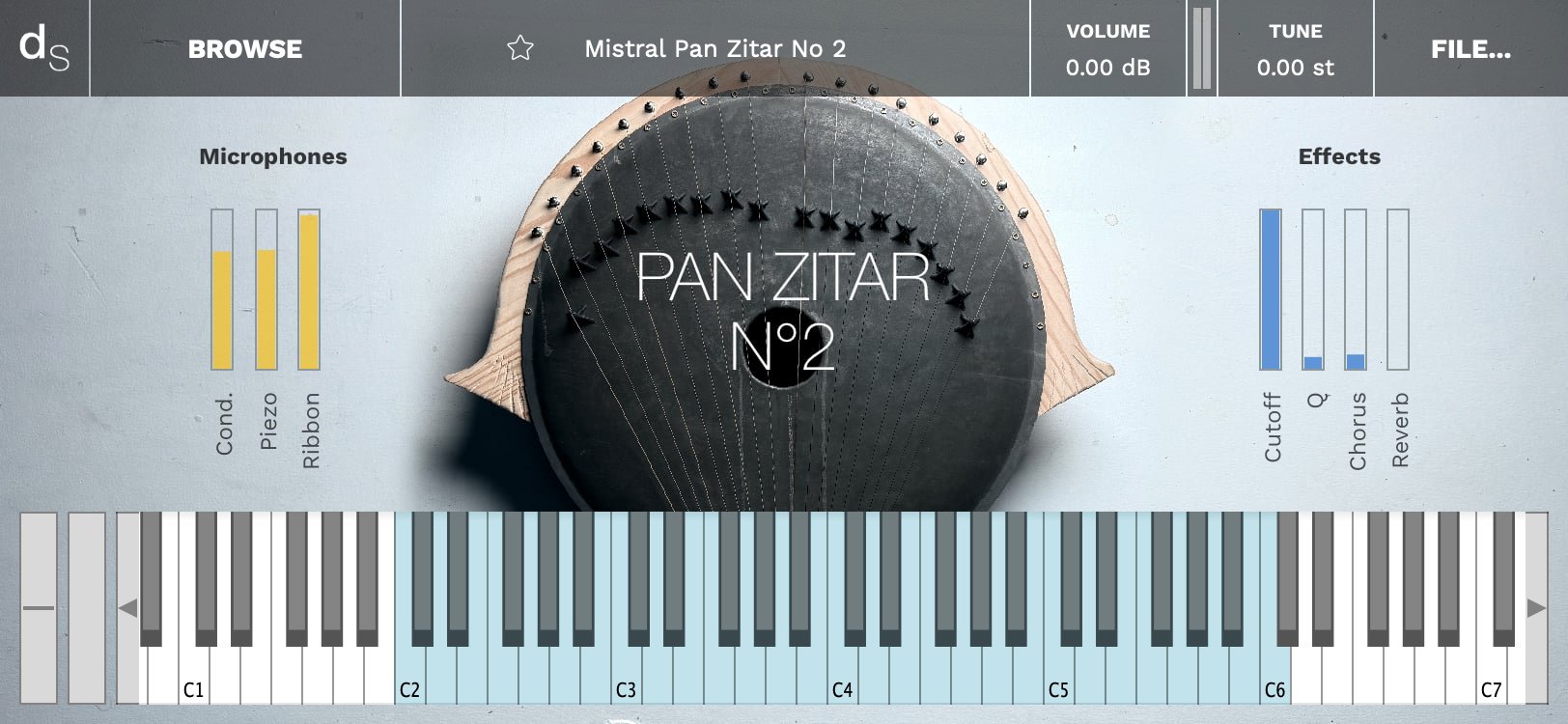
As always, this sample library works with the free decent sampler plugin. In fact, it can be downloaded directly from within the plugin, assuming you use the same email address for Patreon as you do for Decent Sampler.
Enjoy!
– Dave
![Lewis E. Pyle Violin [Kontakt, Ableton, SFZ] - FREE](https://www.decentsamples.com/wp-content/uploads/2019/02/Lewis-E-Pyle-Violin-Cover-Art-Idea-1-324x324.jpg)



Reviews
There are no reviews yet